
Socio: Universidad Privada Boliviana – Bolivia
Energy Efficiency of Solar LED Street Lighting
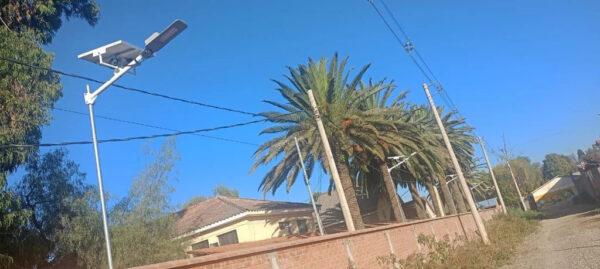
Description: The Remote Laboratory for Solar photovoltaic LED Street Lighting lets students run experiments on street lighting, focusing on energy efficiency and light distribution.
These experiments involve autonomous streetlights powered by solar panels that store energy in batteries for nightime use.
The lab allows for real-time virtual analysis of lamp performance, including efficiency and light output, without needing on-site presence. It also facilitates detailed characterization of light spread for optimal brightness and uniformity. Lastly, IoT control enables remote, automated dimming of lights based on ambient conditions or traffic, optimizing energy use and extending lamp life.
Type of lab: Real-time
Instructor: Omar Ormachea
Module title: Theory: Street Light Remote Lab
Theory Link in public part of repository: https://time.learnify.se/l/s.html#VOZKX?lang=en
Module title: Practical: Street Light Remote Lab
Platform Utilization Link in public part of repository: https://time.learnify.se/l/s.html#Z6mRQ
Booking system link:https://eubbc-digital.upb.edu/booking/lab-structure;id=26
Partner: Universidad Mayor de San Simón – Bolivia
Remote Solar Lab for Dispatch Energy Optimization and Analysis
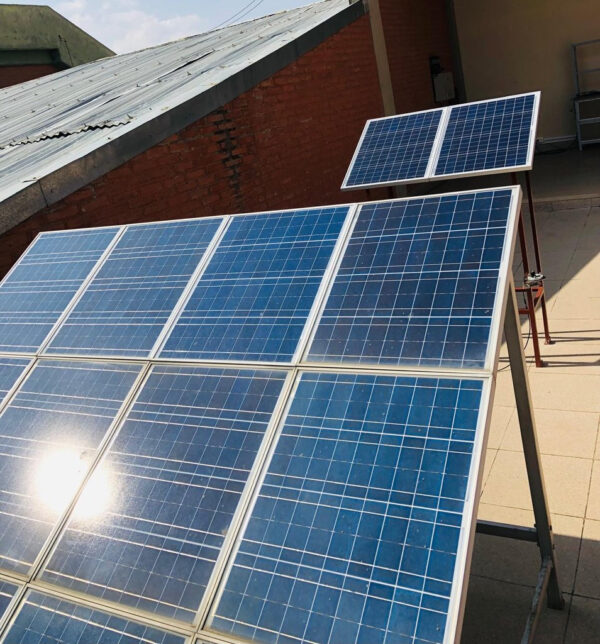
The laboratory consists of solar PV panels, battery, control devices and a load bank which follows an electricity demand profile that is remotely programmed by the user (the electricity demand data for one day is uploaded in a web-based platform).
This demand can be similar to a typical house in a rural area, for example. Then the system is working supplying the electricity demand profile which is followed by switching on different physical resistances. All the parameters are monitored.
Type of lab: Real-time
Instructor: Johnny Villarroel
Module title: Energy Dispatch Optimization: Main Concepts and Importance for Small Decentralized Systems
Theory Link in public part of repository: https://time.learnify.se/l/s.html#zplmm
Module title: Remote Solar Lab for Energy Dispatch Optimization, Tutorial
Platform Utilization Link in public part of repository: https://time.learnify.se/l/s.html#jRO5z
Booking system link: https://eubbc-digital.upb.edu/booking/lab-structure;id=23
Partner: Universidad Mayor de San Andrés – Bolivia
Pyrolytic Conversion of Biomass Remote Lab
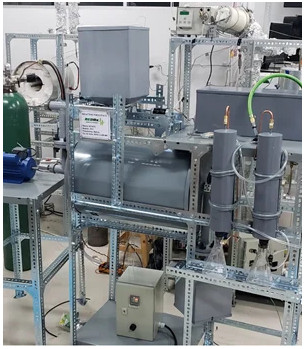
The Pyrolytic Conversion of Biomass Remote Lab enables students to emulate experiments of pyrolysis in an AUGER type reactor using experimental data obtained in a laboratory.
The laboratory was implemented using the ultra – concurrent modality since the reactor is able to get to risky situation through a bad manipulation of the process variables, however the data that will be available for this remote lab is entirely obtained in real experiments which will be available to the students through a web interface which will associate the mass distribution of products to the operational conditions set up.
The lab offers the capability to obtain mass distribution of several set up configurations such as temperature, heating rate, process time and feed stock type.
This lab empowers students to apply their knowledge in practice and gain a deeper understanding of the theory of thermochemical processes.
Type of lab: Ultra-concurrent
Instructor: Rodrigo Surculento
Module title: Theory: BIOCHAR: Impact of temperature and feedstock raw material
Theory Link in public part of repository: https://time.learnify.se/l/s.html#XD5xg?lang=en
Module title: Practical: Electrochemical analysis of lithium-ion batteries
Platform Utilization Link in public part of repository: https://time.learnify.se/l/show.html#att/DkY5k?lang=en
Booking system link: https://eubbc-digital.upb.edu/booking/lab-structure;id=53
Partner: Universidad Mayor de San Andrés – Bolivia
Electrochemical Analysis of Lithium-ion Batteries Remote Lab
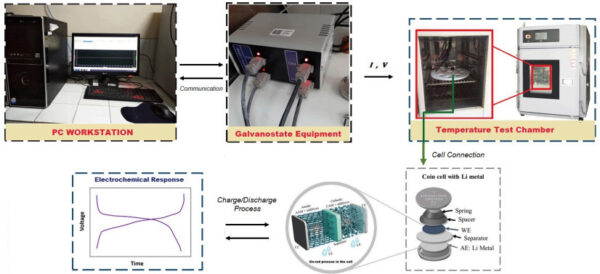
The aim of the Remote Lab of «Electrochemical analysis of lithium-ion batteries» is bridge the gap between theoretical knowledge and practical application of lithium-ion batteries mechanism by providing remote experiences with electrochemical testing.
Through this remote lab, students will learn how theoretical concepts like current variations cutoff voltage and temperature effects impact in the battery performance.
By interpreting electrochemical curves and understanding the effects of varying experimental conditions, students will gain a deeper appreciation and enhancing their overall understanding of lithium-ion battery technology.
Type of lab: Ultra-concurrent
Instructor: Daniel Pantoja / Max Vargas
Module title: Theory: Lithium-ion batteries manufacturers
Theory Link in public part of repository: https://time.learnify.se/l/s.html#gJpQr
Module title: Practical: Electrochemical analysis of lithium-ion batteries
Platform Utilization Link in public part of repository: https://time.learnify.se/l/s.html#W6Ppx
Booking system link: https://eubbc-digital.upb.edu/booking/lab-structure;id=29
Partner: Universidad Nacional de Ingeniería – Perú
Optimization of Parameters for the Flocculation Process in Water Treatment
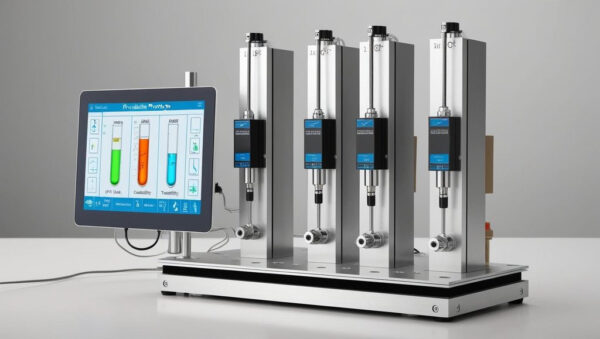
In this remote laboratory practice, students will explore the flocculation process, a key technique in water treatment. Flocculation involves the formation of larger particles, known as flocs, from dissolved or suspended substances, which facilitates their subsequent removal by sedimentation or filtration.
The experiment is based on the formation of iron hydroxide flocs, generated from a mixture of iron salts, citrate, and air, which is activated by exposure to ultraviolet (UV) light. This photochemical reaction allows iron to precipitate in the form of oxides or hydroxides, forming visible flocs that capture various impurities present in the water.
Although in this case the experiment is applied to arsenic removal as an example, the main objective is for students to understand the operation and efficiency of the flocculation process in general, and how it can be applied in different contexts of water treatment.
Type of lab: Real-time
Instructor: Edward Carpio
Module title: Theory: Quick filter design. Direct filtration plants, Slow filtration plants and Disinfection
Theory Link in public part of repository: https://time.learnify.se/l/s.html#31OyR?startId=682BR&lang=en
https://time.learnify.se/l/s.html#jRL0P?startId=mZGY9&lang=en
https://time.learnify.se/l/s.html#L9nvX?startId=OYq8Y&lang=en
Module title: Practical: Optimization of parameters for the flocculation process in water treatment
Platform Utilization Link in public part of repository: https://time.learnify.se/l/s.html#n5YJE?startId=qxV8G&lang=en
Booking system link: https://eubbc-digital.upb.edu/booking/lab-structure;id=61
Partner: Pontificia Universidad Católica del Perú – Perú
Air Quality and Ventilation for Indoor Spaces
This remote laboratory allows the students to study the operational parameters of a ventilation system that pollutants and ventilation parameters to ensure optimal Indoor Air Quality.
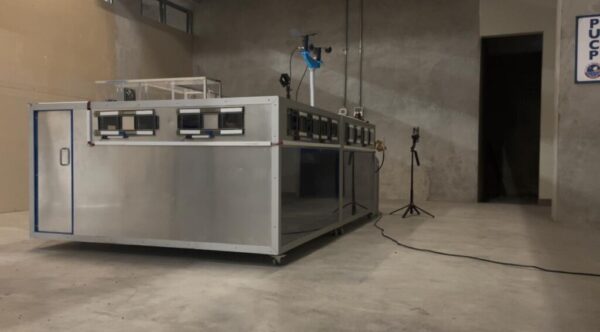
The laboratory test bench allows for the design of multiple experiments and the testing of different conditions.
The test bench contains two main ventilation options. Natural ventilation, through automatic windows and a door, and a mechanical ventilation system. This way the students can compare or combine both ventilation methods.
The bench also allows for simulation of occupation of spaces using Carbon Dioxide as a proxy for occupants. The CO2 is injected in the space at a real-time adjustable rate. This way the students can model different scenarios such as classrooms, laboratories or theatre functions.
Lastly, IoT controls enables remote control of windows, door, ventilators, dampers and injection of CO2. Also, the module has windspeed, CO2, temperature and humidity sensors.
Type of lab: Real-time
Instructor: Andrea Rondón
Module title: Theory: Air Quality & Ventilation
Theory Link in public part of repository: https://time.learnify.se/l/show.html#att/82W85
Module title: Practical: ACH Measurements Using CO2
Platform Utilization Link in public part of repository: https://time.learnify.se/l/show.html#att/XDpyV
Booking system link: https://eubbc-digital.upb.edu/booking/lab-structure;id=54
Partner: Escuela Politénica Nacional – Ecuador
Remote Photovoltaic Laboratory
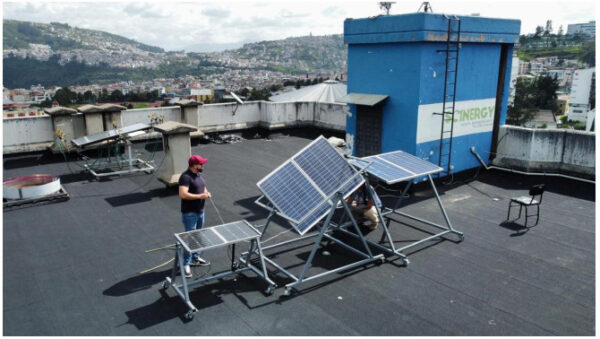
The Remote Laboratory for Photovoltaic Systems enables students to conduct experiments on solar panel performance and environmental effects on energy production.
Through an interactive web interface, users can control and monitor real-time data from solar tracking systems, panel cleaning mechanisms, and spectral analysis setups.
The lab includes various panel configurations, such as single- and dual-axis trackers, filtered panels, and washing systems, allowing comprehensive analysis of solar efficiency under diverse conditions.
This setup supports remote experimentation on energy yield, spectral irradiance, and system optimization, fostering hands-on learning without the need for physical presence.
Type of lab: Real-time
Instructor: Juan Molina
Module title: Practical: Single-Axis Adjustable Solar Panel System: Power Optimization through Angular Control, Dual-Axis Adjustable Solar Panel System: Improved performance through tilt control, Self-Cleaning Solar Panel System: Performance Evaluation Before and After Cleaning
Platform Utilization Link in public part of repository: https://time.learnify.se/l/show.html#att/0RDWN
https://time.learnify.se/l/show.html#att/Kr9g8 https://time.learnify.se/l/show.html#att/v2Lnn
Booking system link: https://eubbc-digital.upb.edu/booking/lab-structure;id=31